UK study and passage preparation
UK COLREG revision for Day Skipper and Yachtmaster learners
Practise IRPCS encounters, lights, day shapes, fog signals and Region A buoyage alongside your Day Skipper or Yachtmaster studies.
The essentials
Start with the situation
Day Skipper and Yachtmaster learners need to apply the collision regulations as well as recognise their signals. An oral explanation or practical encounter brings the pieces together: what can you observe, which rule applies, what must each vessel do, and how will you check the action worked?
Use RulesAtSea as a focused revision companion to your course materials and time on the water. The exercises cover selected international encounters, lights, day shapes, sound signals, restricted visibility and Region A navigation marks. They are original teaching situations, not official examination questions.
This guide covers: Supplementary International COLREG / IRPCS and Region A practice. RulesAtSea is independent and does not provide an RYA or MCA course, assessment or certificate.
Place collision rules within the wider course
The RYA describes Day Skipper Theory as an introduction to navigation and seamanship that includes collision regulations alongside chartwork, tides, weather, safety and other subjects. Coastal Skipper/Yachtmaster Offshore Theory develops navigation and seamanship further. A strong simulator score cannot demonstrate completion of either syllabus.
Keep a revision list from your own course or assessment requirements. Use the guides for the topics they teach and your course provider’s material for the full scope. The fictional chart and harbour exercises add observation practice, but do not replace tidal calculations, passage planning, pilotage instruction or practical boat handling.
First explain the duties of both vessels
Begin with a crossing, head-on and overtaking encounter. Before choosing an action, state whether the vessels are in sight, whether collision risk exists and what each vessel must do. Add a power-and-sail encounter, then revisit the assumptions: overtaking, channel constraints and vessel operation can change a simple answer.
Finish this round with a stand-on vessel whose give-way contact does not act. Explain the stages of Rule 17 and why maintaining course and speed does not excuse ignoring the developing danger. The replay helps you connect an early decision to the later amount of water and time available.
Put this into practice
A vessel to starboard
Recognise the give-way vessel in a crossing situation.COLREGs Rules 15 & 16Practise this situationMeeting head-on
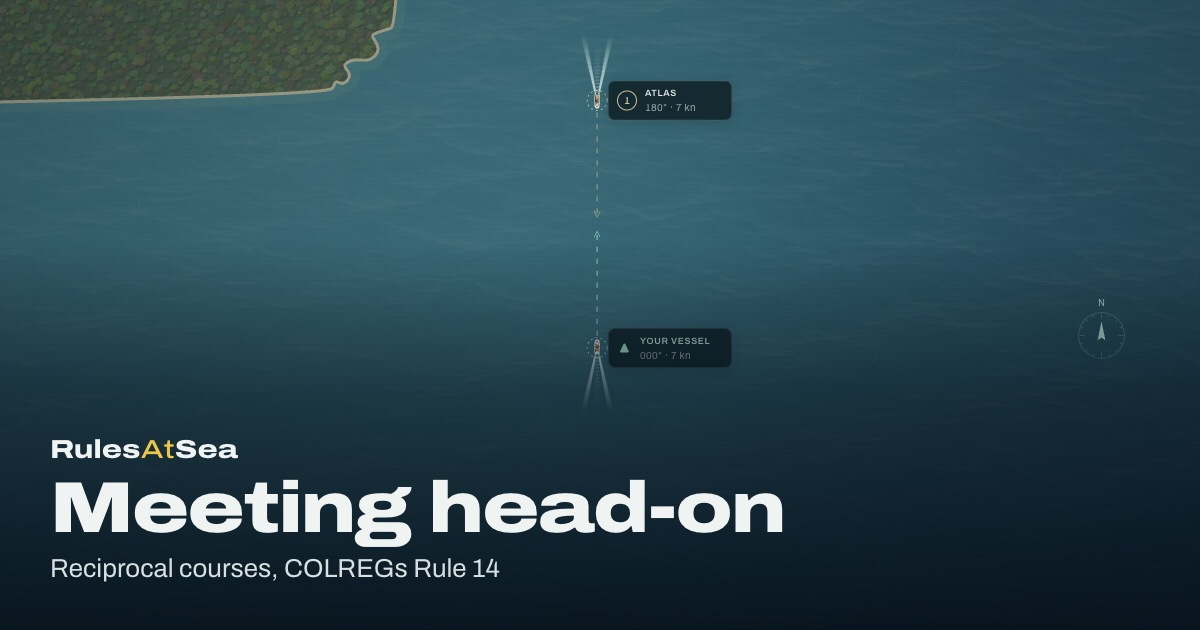
Apply the mutual starboard action for a head-on meeting.COLREGs Rule 14Practise this situationComing up from astern
Keep clear until the overtaken vessel is finally past and clear.COLREGs Rule 13Practise this situationPower meets sail
Distinguish vessel responsibility from the crossing rule for two power-driven vessels.COLREGs Rule 18Practise this situationWhen the give-way vessel does nothing
Stand on first, then know when and how a stand-on vessel must act, and why not to turn to port for a vessel on the port side.COLREGs Rule 17Practise this situation
Revise lights and shapes as observed evidence
For a night display, name the colours, vertical order and directional aspect you can see. Then identify the operation or status and discuss what remains unknown. For a day shape, count the signals and describe cone directions before recalling the label. This approach helps when an examiner presents an unfamiliar viewpoint.
Pair not-under-command lights with the two-ball day signal, and restricted-manoeuvrability lights with ball–diamond–ball. Compare fishing cones with the motor-sailing cone. Avoid learning a vessel ranking that ignores the actual encounter or assuming that a familiar hull proves a legal status.
Put this into practice
Red over red
Recognise a vessel not under command that is making way.COLREGs Rule 27(a)Practise this situationRed, white, red
Recognise a vessel restricted in her ability to manoeuvre and distinguish her from similar configurations.COLREGs Rule 27(b)Practise this situationGreen over white
Distinguish trawling from other fishing and read the aspect from the sidelight.COLREGs Rule 26Practise this situationDay shape · Not under command
Recognise the day signal for not under command and distinguish its legal meaning from hull appearance.COLREGs Rule 27(a)Practise this situationDay shape · Restricted ability to manoeuvre
Recognise the day signal for restricted ability to manoeuvre and distinguish its legal meaning from hull appearance.COLREGs Rule 27(b)Practise this situationDay shape · Sailing vessel using machinery
Recognise the day signal for sailing vessel using machinery and distinguish its legal meaning from hull appearance.COLREGs Rule 25(e)Practise this situation
Listen and give the reason for your response
Alternate manoeuvring signals with restricted-visibility signals so that context forms part of your answer. Distinguish short from prolonged blasts and astern propulsion from astern movement. Practise an overtaking proposal and its reply, including a case where the proposed passage is unsafe.
Move into fog and explain why Rule 19 applies when the other vessel is not in sight. Assess safe speed and the limitations of radar-only or sound-only information. When a signal is apparently ahead, state the qualifications and required caution rather than offering a fixed speed or a universal turn direction.
Put this into practice
The engines change
Interpret the complete signal within its applicable context.COLREGs Rule 34(a)Practise this situationAnswer the overtaking proposal
Give the International overtaking agreement and take steps to permit safe passing.COLREGs Rules 9(e), 13 & 34(c)Practise this situationThe passage is occupied
Express doubt when a narrow-channel overtaking proposal is unsafe.COLREGs Rules 9(e) & 34(d)Practise this situationA contact on the radar
Take avoiding action on a radar contact forward of the beam without turning to port.COLREGs Rule 19Practise this situationA fog signal ahead
Reduce to the minimum speed at which course can be kept, then take all way off if necessary.COLREGs Rule 19(e)Practise this situation
Connect Region A buoyage with a harbour approach
For UK buoyage revision, select exercises labeled Region A. Follow the stated conventional direction: red port-hand marks and green starboard-hand marks. On the outward leg the passing side relative to your vessel reverses, while the mark’s definition stays the same. Cardinal marks require compass direction rather than a port-or-starboard mnemonic.
Try the linked Region A harbour voyage after individual mark practice. Read the fictional chart, choose a junction branch, align leading marks, answer an obscured bend signal and assess channel traffic. Use this sequence before a passage as a prompt to review actual charted hazards, local directions, weather and a suitable plan with the crew.
Put this into practice
Entering harbour at dusk
Follow IALA Region A lateral marks when entering from seaward.IALA lateral marks, Region APractise this situationLeaving the channel · Region A
Apply lateral buoyage on an outward passage without swapping the physical mark definitions.IALA lateral marks · Region APractise this situationYellow below, black above
Read a north cardinal mark and pass on its named side.IALA cardinal marksPractise this situationA fork in the channel · Region A
Connect preferred-channel appearance to a charted route and its hazards.IALA modified lateral marks · preferred channelPractise this situationHaven approach · A · day · plan
Plan an approach from multiple chart features before relying on a visual cue.Chart 1 · approach planningPractise this situation
Make each revision session explainable
Choose a small mix of encounters and recognition tasks. After each one, write the observation you missed or the rule qualification you omitted. Return to the governing text, then repeat the situation without relying on its title. Accuracy of explanation is a more useful revision target than memorising the location of an answer.
For a particular oral or professional examination, use its current published syllabus and instructor guidance to check every required subject. This page supports the collision-rule subset it describes and makes no claim of official endorsement, exam completeness or guaranteed results.
Take the watch in the simulator
Explore an authored situation, make your decision, then see the result and the rule behind it.
Questions from the watch
Common questions
Is RulesAtSea an official RYA course or exam?
No. It is independent supplementary practice. Use an appropriate course provider for instruction, assessment and qualifications.
Can I use this before a sailing voyage as well as an exam?
Yes. Practise the encounters, lights, marks and visibility conditions relevant to your route, then complete the actual passage preparation using current charts, forecasts and local instructions.
Sources and further reading
Use these references for the full rules, official guidance and course requirements.
- RYA · Day Skipper Theory course
- RYA · Coastal Skipper/Yachtmaster Offshore Theory course
- RYA · Do you know your COLREGs?
- US Coast Guard · International COLREGs
Read the International provisions. The same publication also marks US Inland differences, which these exercises do not teach.
- IALA · R1001 Maritime Buoyage System
The international reference for Regions A and B and the characteristics of navigation marks.
Updated