International collision rules
COLREGs: practise the rules of the road at sea
Understand crossing, head-on and overtaking situations, give-way and stand-on duties, then practise the international collision rules in RulesAtSea.
The essentials
Start with the situation
The COLREGs are the International Regulations for Preventing Collisions at Sea. In the UK you will also hear IRPCS. They explain how vessels assess collision risk, act around one another and communicate through lights, shapes and sounds. Learning them means connecting an observed situation to the appropriate duty.
If you are searching for boat right of way, begin with give-way and stand-on responsibilities. These terms help explain what each vessel should do, while keeping attention on the shared purpose: avoid a collision. RulesAtSea lets you choose an action and watch the encounter develop.
This guide covers: International COLREGs / IRPCS. Apply the rule to the visibility, vessel operation and waterway in the situation.
Start with lookout and collision risk
Before naming the encounter, establish what is happening. Can the vessels see one another? What are their courses, speeds and operations? Is a narrow channel or traffic separation scheme involved? Rules 5–8 provide the foundation: proper lookout, safe speed, assessment of risk and effective avoiding action.
An approaching vessel whose compass bearing barely changes can be a collision risk. Take repeated observations rather than relying on one glance. A changing bearing can still hide danger at close range, with a large ship or with a tow. If you are uncertain whether risk exists, the rules require you to treat it as existing.
- Observe by sight, hearing and the other available means appropriate to the conditions.
- Check both the bearing and the closing distance.
- After acting, continue checking that the vessels will pass safely.
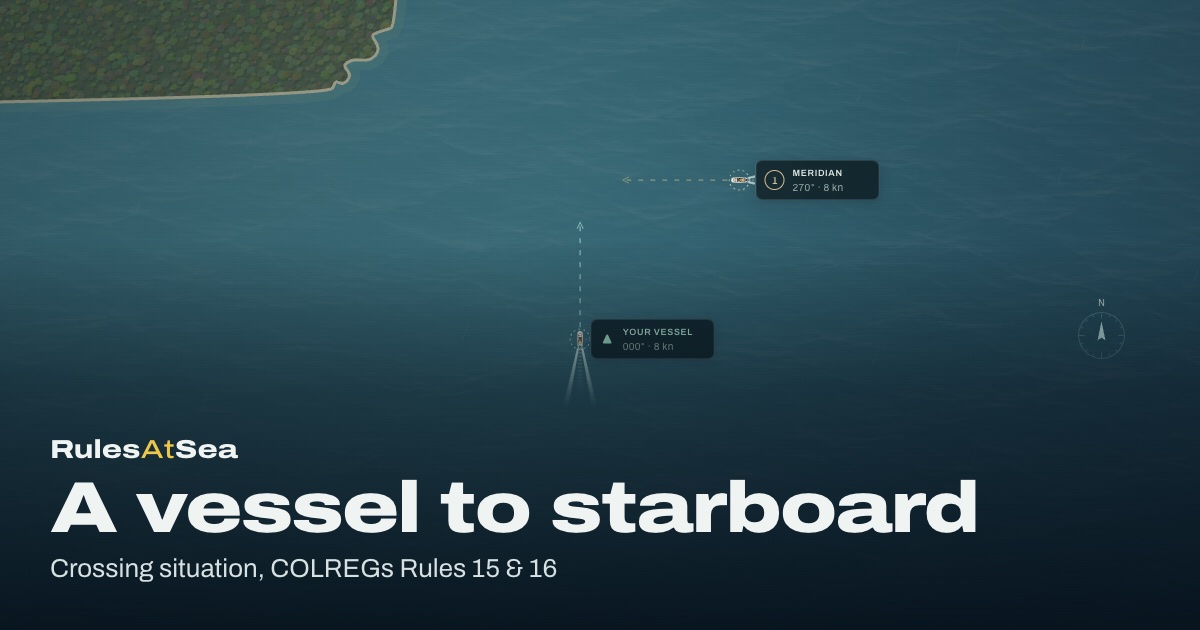
Crossing: a vessel on your starboard side
Rule 15 applies when two power-driven vessels in sight are crossing with risk of collision. The vessel with the other on her starboard side keeps out of the way and, when circumstances allow, avoids crossing ahead. Rule 16 calls for early, substantial action to keep well clear.
In the crossing exercise, watch the contact on your starboard bow before choosing a manoeuvre. Use the replay to see whether your decision creates room. The angle that works in one authored scene is an exercise choice, not a universal course alteration for every crossing.
Head-on and overtaking need different decisions
When two power-driven vessels in sight meet on reciprocal or nearly reciprocal courses with risk of collision, Rule 14 calls for both to alter to starboard and pass port to port. If in doubt whether it is head-on, assume it is and act accordingly. Identify this from the combined aspect and situation, rather than the presence of one light alone.
Rule 13 places the duty to keep clear on any overtaking vessel. The overtaking sector begins more than 22.5° abaft the other vessel’s beam. That duty continues until finally past and clear; a later change of bearing does not turn the encounter into a fresh crossing situation. A sailing vessel overtaking a power-driven vessel is still the overtaker.
Stand-on still means keeping watch
Rule 17 initially requires the stand-on vessel to keep course and speed. It also describes when she may act because the give-way vessel is not taking appropriate action, and when she must act because that vessel’s action alone can no longer avoid collision. Continue assessing the encounter throughout those stages.
Do not reduce the rules to “the larger boat goes first” or “sail always has priority.” Overtaking, channels, traffic schemes and the vessels’ actual operations matter. The power-and-sail and late-action exercises help you explain the relevant duty before choosing what to do.
Put this into practice
Power meets sail
Distinguish vessel responsibility from the crossing rule for two power-driven vessels.COLREGs Rule 18Practise this situationWhen the give-way vessel does nothing
Stand on first, then know when and how a stand-on vessel must act, and why not to turn to port for a vessel on the port side.COLREGs Rule 17Practise this situation
Use the simulator to explain your decision
For each exercise, say what you observed, which rule applies and what you expect the other vessel to do. Choose your action, watch the result and read the explanation. On the next attempt, identify the evidence before recalling the answer. This makes a familiar picture useful preparation for a less familiar encounter.
Before a voyage, revise the situations likely on your route: open-water encounters, a channel crossing, traffic lanes or poor visibility. Use current charts, local instructions and the full regulations for the actual passage. The simulator provides practice of authored situations, not a navigational instruction for live traffic.
Questions from the watch
Common questions
Are COLREGs and IRPCS different rules?
Both names refer to the international collision regulations. IRPCS is a familiar term in UK training. Always check national and local provisions for the waters you intend to use.
Does the stand-on vessel have an unconditional right of way?
No. Rule 17 gives the stand-on vessel responsibilities that change as an encounter develops. All vessels must maintain a proper lookout and assess collision risk.
Sources and further reading
Use these references for the full rules, official guidance and course requirements.
- US Coast Guard · International COLREGs
Read the International provisions. The same publication also marks US Inland differences, which these exercises do not teach.
- IMO · Convention on the International Regulations for Preventing Collisions at Sea
Updated