Daytime vessel signals
Day shapes: black balls, cones, diamonds and cylinders
Recognise COLREG day shapes for anchor, fishing, motor sailing, long tows and vessel restrictions, with linked simulator recognition exercises.
The essentials
Start with the situation
Day shapes are daytime signals that communicate a vessel’s operation or status. The common shapes are a ball, cone, diamond and cylinder. Their arrangement matters as much as the individual shape: one ball, two balls and three balls communicate different things.
Learn to describe what you see before assigning a label. Count the shapes, read their order from top to bottom and check the direction of cone apexes. The simulator’s day-shape exercises let you inspect an explicit signal rather than guess a vessel’s legal status from its hull.
This guide covers: International COLREG day shapes. Recognition examples cover selected signals; the full rules include additional displays and exceptions.
One, two or three black balls
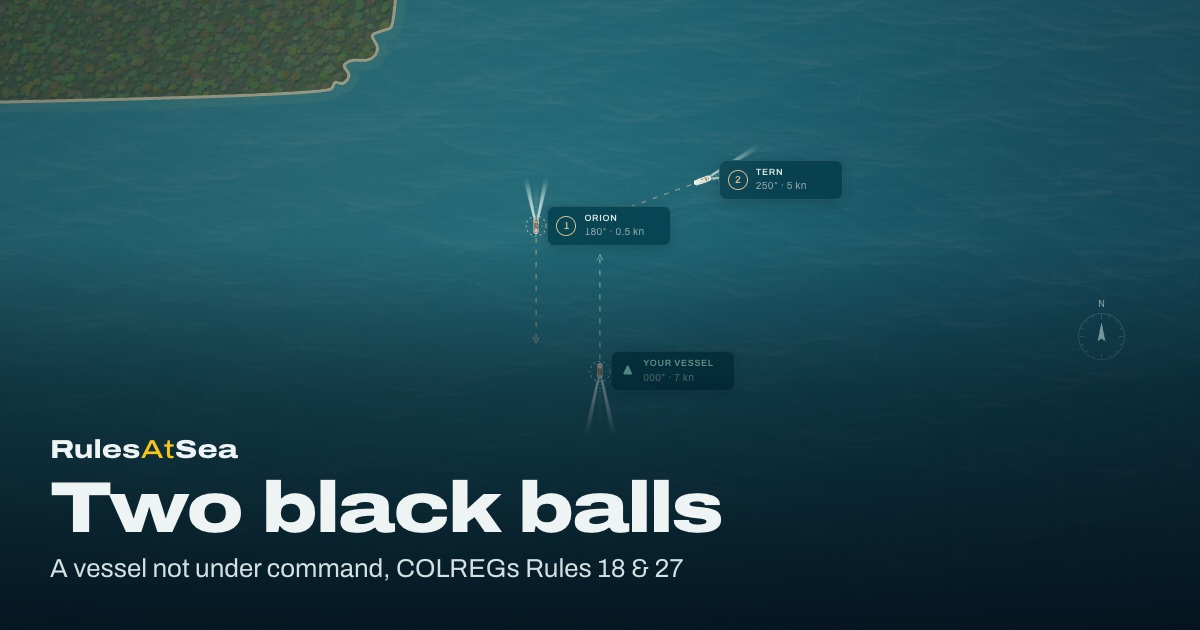
A single black ball is the general day signal for a vessel at anchor under Rule 30. Two black balls in a vertical line indicate not under command under Rule 27. Three black balls in a vertical line indicate aground under Rule 30. The full rule determines which display is required for a particular vessel and contains exceptions.
These meanings explain why speed alone is insufficient. A vessel can be stopped but underway, anchored, aground or unable to manoeuvre because of an exceptional circumstance. The distinction changes the information another mariner needs. Give an anchored vessel appropriate space for her hull and swing; a mark or shape does not prescribe one universal passing distance.
Put this into practice
Day shape · At anchor
Recognise the day signal for at anchor and distinguish its legal meaning from hull appearance.COLREGs Rule 30(a)Practise this situationDay shape · Not under command
Recognise the day signal for not under command and distinguish its legal meaning from hull appearance.COLREGs Rule 27(a)Practise this situationDay shape · Aground
Recognise the day signal for aground and distinguish its legal meaning from hull appearance.COLREGs Rule 30(d)Practise this situation
Ball–diamond–ball and the black cylinder
Ball–diamond–ball identifies a vessel restricted in her ability to manoeuvre because of the nature of her work. Examples include some surveying, cable work and underwater operations. It differs from not under command, which arises from an exceptional circumstance. The operation and the applicable encounter still need to be understood.
A power-driven vessel constrained by her draught may show a black cylinder under Rule 28. This status concerns draught in relation to the available depth and width, severely limiting deviation from her course. It is not a generic label for a large ship. Rule 18 sets out the relevant responsibilities, including action by other vessels to avoid impeding her safe passage when circumstances admit.
Some operations use additional shapes, such as dredging signals showing an obstruction side and a side where another vessel may pass. Ball–diamond–ball recognition is a starting point; the complete display and the full text of Rule 27 provide the detail.
Put this into practice
Day shape · Restricted ability to manoeuvre
Recognise the day signal for restricted ability to manoeuvre and distinguish its legal meaning from hull appearance.COLREGs Rule 27(b)Practise this situationDay shape · Constrained by draught
Recognise the day signal for constrained by draught and distinguish its legal meaning from hull appearance.COLREGs Rule 28Practise this situation
Fishing cones and a motor-sailing cone
Two cones with their apexes together identify a vessel engaged in fishing under Rule 26. The definition refers to fishing apparatus that restricts manoeuvrability. A boat with fishing rods or trolling lines is not automatically a vessel engaged in fishing for these purposes. The same basic fishing day shape is used for trawling and other qualifying fishing.
A vessel under sail that is also propelled by machinery displays a cone with its apex down, forward where it can best be seen, under International Rule 25(e). She is power-driven for the steering and sailing rules. Look for the signal and the actual operation rather than assuming that raised sails alone establish a sailing vessel.
Put this into practice
Day shape · Engaged in fishing
Recognise the day signal for engaged in fishing and distinguish its legal meaning from hull appearance.COLREGs Rule 26Practise this situationDay shape · Sailing vessel using machinery
Recognise the day signal for sailing vessel using machinery and distinguish its legal meaning from hull appearance.COLREGs Rule 25(e)Practise this situationPower meets sail
Distinguish vessel responsibility from the crossing rule for two power-driven vessels.COLREGs Rule 18Practise this situation
A diamond can warn of a long tow
Rule 24 prescribes a diamond for a tow exceeding 200 m, measured from the stern of the towing vessel to the after end of the tow. Where prescribed it is displayed by the towing vessel and by the vessel or object being towed. A towing relationship may be difficult to appreciate from one vessel alone, so keep looking for the rest of the operation.
A long tow is not automatically a vessel restricted in her ability to manoeuvre. The Rule 3 definition and the operation determine whether that status applies. This is a useful revision example because memorising “diamond equals towing” misses both the length condition and the distinct ball–diamond–ball signal.
Connect recognition to a safe encounter
Answer each recognition exercise in two stages: describe the observed pattern, then explain the operation it identifies. After feedback, compare the most easily confused signals: two balls with three balls, one downward cone with fishing cones, and a single diamond with ball–diamond–ball.
When preparing for a voyage or exam, revisit the matching night lights as a separate task. A daytime signal and a night display may describe the same status, but they are different observations. Neither removes the need to consider visibility, collision risk, channels, traffic schemes and the responsibilities of both vessels.
Questions from the watch
Common questions
Do day shapes show which vessel always goes first?
They communicate an operation or status. The applicable steering rules, visibility and waterway constraints determine the duties in the encounter.
Do fishing cones distinguish trawling from other fishing?
The basic two-cones-apexes-together signal is shared. The night lights differ, and additional fishing signals may be required for outlying gear.
Sources and further reading
Use these references for the full rules, official guidance and course requirements.
- US Coast Guard · International COLREGs
International Rules 3, 18 and 24–30 explain vessel status, shapes and responsibilities. Annex I provides technical requirements.
- IMO · Convention on the International Regulations for Preventing Collisions at Sea
Updated