Read the lights
Navigation lights: identify boats and vessels at night
Learn boat navigation light colours, viewing sectors and vessel status, then identify lights at night in the RulesAtSea simulator.
The essentials
Start with the situation
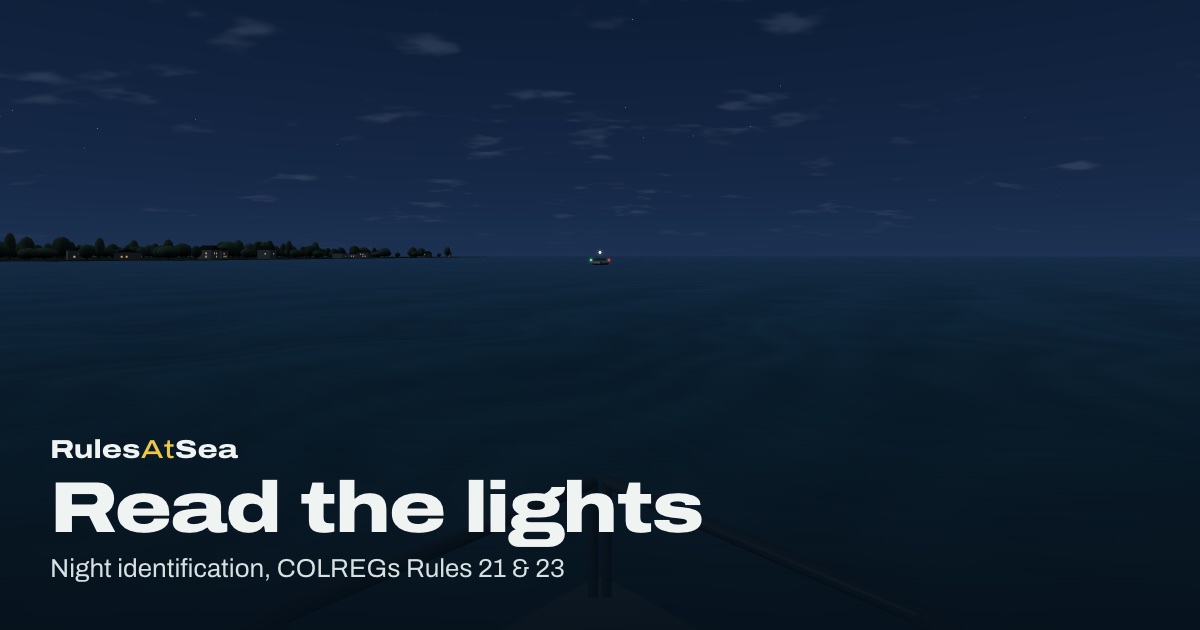
Navigation lights communicate both the aspect of a vessel and, in some combinations, her operation or status. Reading boat lights at night starts with colour and arrangement, then asks which lights you would see from your position. The same vessel can look very different from ahead, abeam and astern.
RulesAtSea provides night scenes in which you inspect a display before answering. Use the examples to practise observation and recognition, then connect the identification to the relevant collision rules. A named vessel status alone does not decide every encounter.
This guide covers: International COLREG lights, with practical identification examples. The full display depends on operation, size and the applicable exceptions.
Red, green and white tell you about aspect
Under Rule 21, the port sidelight is red and the starboard sidelight is green. Each covers 112.5°, from ahead to 22.5° abaft its respective beam. A white masthead light covers 225° across the forward sectors; the white sternlight covers 135° aft. An all-round light has a 360° horizontal sector.
A masthead light is defined by its placement and sector, not simply by being at the very top of a mast. Look at the complete arrangement. A single white light can have several explanations, including a sternlight, an anchor light or a permitted small-vessel display. Its colour alone cannot establish the vessel’s status or heading.
Recognise a power-driven vessel underway
The general Rule 23 display includes a forward masthead light, sidelights and a sternlight. A second masthead light is aft and higher: it is required at 50 m and above and may also be carried by a shorter vessel. Smaller vessels have alternative permitted displays, so do not infer an exact length from one glimpse.
Seeing both sidelights with the appropriate masthead aspect can help identify a vessel ahead or nearly ahead. Seeing a green sidelight shows her starboard aspect. Combine that observation with relative movement and risk of collision before classifying the encounter. The large-vessel exercise asks you to read the relationship between the white lights and the visible sidelight.
Learn the vertical combinations in context
Two all-round red lights identify a vessel not under command. All-round red–white–red indicates restricted ability to manoeuvre arising from the nature of her work. A trawling vessel shows all-round green over white; a vessel engaged in fishing other than trawling shows red over white. A pilot vessel on pilotage duty shows white over red.
These are identifying elements of a display, not an exhaustive description of every light carried. A vessel making way may show sidelights and a sternlight in addition, depending on the applicable rule. Fishing gear, underwater operations and towing can require further signals. Read Rules 24–29 when revising those operations.
- Describe the colours from top to bottom.
- Distinguish all-round status lights from directional navigation lights.
- Check for additional lights before deciding what the whole display means.
Put this into practice
Red over red
Recognise a vessel not under command that is making way.COLREGs Rule 27(a)Practise this situationRed, white, red
Recognise a vessel restricted in her ability to manoeuvre and distinguish her from similar configurations.COLREGs Rule 27(b)Practise this situationGreen over white
Distinguish trawling from other fishing and read the aspect from the sidelight.COLREGs Rule 26Practise this situationWhite over red
Recognise a pilot vessel on duty and tell it apart from a fishing vessel.COLREGs Rule 29Practise this situation
Separate anchored, underway and making way
Underway means neither anchored, made fast to shore nor aground. A vessel can be underway while stopped and making no way through the water. Anchored vessels generally show the Rule 30 white all-round anchor display; for vessels 50 m and above the aft anchor light is lower than the forward one. The rule contains size and location exceptions.
The anchored-vessel exercise is useful because two white lights can initially resemble a power-driven display. Consider their arrangement and the absence or presence of other evidence. Do not assume every unchanging white light belongs to shore, or every stopped vessel is at anchor.
Practise the observation before the answer
Inspect the scene from the bridge, use the binoculars where available and say which lights you can actually see. Identify the display, then explain what further information you need to choose an action. Revisit the same scene from the chart view to connect your interpretation with the vessel’s orientation.
Rule 20 requires lights from sunset to sunrise, and prescribed lights, if carried, must also be shown during daylight in restricted visibility. Night identification therefore belongs with lookout and fog revision. Before a passage, confirm your own boat’s required display and use the regulations and equipment instructions for installation details.
Questions from the watch
Common questions
Does red over red mean any vessel that has stopped?
No. It identifies a vessel not under command: an exceptional circumstance prevents her from manoeuvring as the rules require. Being stopped alone does not establish that status.
Can I identify a vessel from one white light?
One white light has several possible meanings. Establish the sector, arrangement, movement and other available evidence before deciding.
Sources and further reading
Use these references for the full rules, official guidance and course requirements.
- US Coast Guard · International COLREGs
International Rules 20–30 cover application, light sectors and vessel displays; Annex I covers positioning and technical details.
- IMO · Convention on the International Regulations for Preventing Collisions at Sea
Updated