Canada · navigation revision
Canadian boating navigation rules and Region B practice
Practise international collision-rule situations and Canadian-relevant Region B buoyage, with a clear guide to what PCOC learners still need.
The essentials
Start with the situation
Canadian boaters learn navigation rules alongside safe operation, equipment and local responsibilities. RulesAtSea offers a place to practise selected international collision situations and the Region B buoyage used in Canada. You can see a crossing develop, identify vessel signals and interpret marks in a fictional approach.
If you are preparing for the Pleasure Craft Operator Card, use these exercises as a focused supplement. They do not provide an accredited PCOC course or test, issue the card or cover the complete Canadian requirements. Transport Canada explains how accredited providers deliver that training and assessment.
This guide covers: International COLREG exercises and labeled IALA Region B buoyage. Canadian national modifications, local rules and complete PCOC examination coverage are outside this practice pack.
Separate shared collision rules from Canadian provisions
Canada’s Collision Regulations set out the international rules with Canadian modifications and additional provisions. The simulator’s collision-rule scenes use the International COLREGs. This distinction matters when moving from a practice scene to a Canadian waterway, especially where local traffic, channel procedures or national provisions apply.
Start by understanding the observed encounter and its shared international duty. Then use the current Canadian regulations and local publications to confirm what applies to your route. Selecting a Region B buoyage exercise changes the marks in that scene; it does not select a Canadian collision-rule jurisdiction.
Put this into practice
A vessel to starboard
Recognise the give-way vessel in a crossing situation.COLREGs Rules 15 & 16Practise this situationMeeting head-on
Apply the mutual starboard action for a head-on meeting.COLREGs Rule 14Practise this situationComing up from astern
Keep clear until the overtaken vessel is finally past and clear.COLREGs Rule 13Practise this situation
Practise Canada’s Region B lateral convention
The Canadian Coast Guard describes a combined lateral-cardinal system. For lateral marks, Region B uses red starboard-hand and green port-hand aids. In the upstream direction, keep the starboard-hand aids to starboard and port-hand aids to port. Establish that direction from the chart and publications; it is generally from seaward toward headwaters or into a harbour.
Choose the labeled Region B exercises here. Identify the red cone or conical topmark and green can or cylindrical topmark, then read the light colour at night. Practise the outward passage as well: travelling against the direction of buoyage reverses which side of your boat leaves each mark. A returning mnemonic is helpful only after the direction is established.
Put this into practice
Starboard-hand mark · Region B · day
Recognise starboard-hand mark · region b from its original daymark portrayal.IALA lateral marks · Region BPractise this situationPort-hand mark · Region B · day
Recognise port-hand mark · region b from its original daymark portrayal.IALA lateral marks · Region BPractise this situationStarboard-hand mark · Region B · night
Recognise starboard-hand mark · region b from its live light.IALA lateral marks · Region BPractise this situationLeaving the channel · Region B
Apply lateral buoyage on an outward passage without swapping the physical mark definitions.IALA lateral marks · Region BPractise this situation
Use cardinal marks, junctions and charted depths together
Cardinal marks use the same meaning in Regions A and B. Their name indicates the compass side of the safest water; body bands, cone topmarks and white light rhythm support identification. An isolated-danger mark identifies a limited danger, while a safe-water or fairway mark has a different meaning and local passing guidance.
The Region B preferred-channel and harbour exercises connect mark recognition to a route choice. A broad contrasting band and a two-plus-one light group identify a modified lateral mark at a junction. Combine that with the chart, available depth and your destination. The original chart-reading examples also let you practise soundings, drying features, wrecks and anchoring restrictions.
Put this into practice
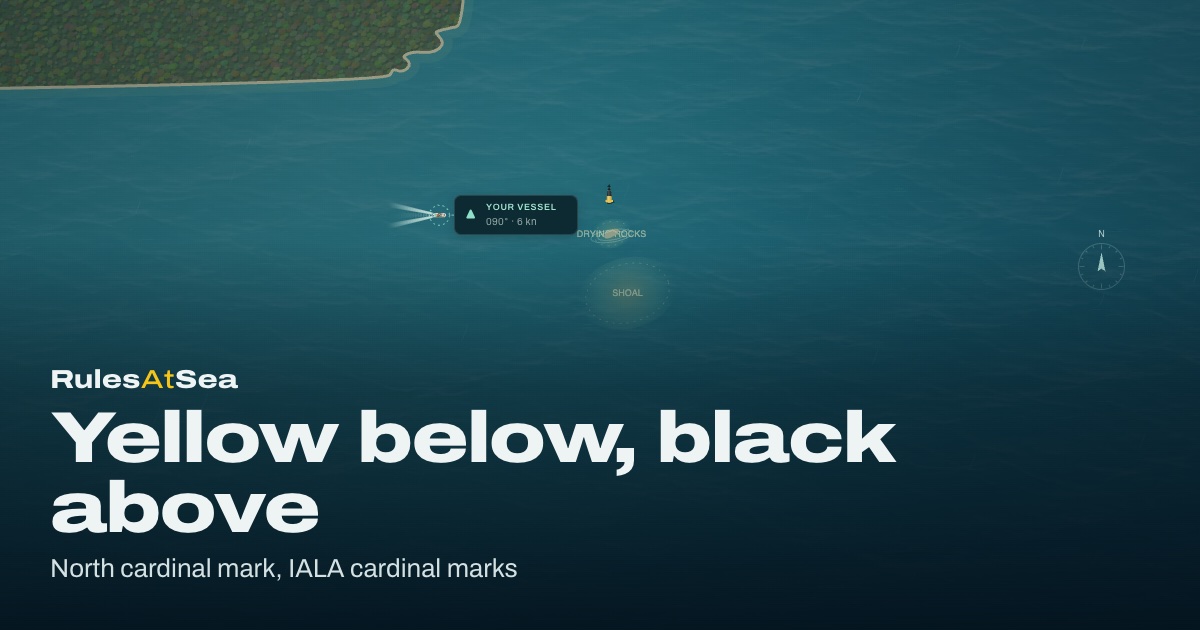
Yellow below, black above
Read a north cardinal mark and pass on its named side.IALA cardinal marksPractise this situationBlack and red, two spheres
Recognise an isolated danger mark and how to pass it.IALA isolated danger marksPractise this situationA fork in the channel · Region B
Connect preferred-channel appearance to a charted route and its hazards.IALA modified lateral marks · preferred channelPractise this situationChoose a passage with enough water
Use charted depths, water level and draught when choosing a passage.Chart 1 · soundings and contoursPractise this situationHaven approach · B · day · plan
Plan an approach from multiple chart features before relying on a visual cue.Chart 1 · approach planningPractise this situation
Recognise a vessel before choosing an encounter action
For collision revision, compare a crossing between two power-driven vessels with a head-on meeting and an overtaking situation. Explain what each vessel should do and keep checking whether the other is acting. Stand-on duties change as the danger develops; the term does not permit ignoring a possible collision.
Add lights and daytime shapes to the same routine. Red and green sidelights show aspect, while certain vertical displays indicate operation or status. Fishing gear must restrict manoeuvrability to establish the COLREG fishing category. A sailing vessel using propulsion machinery is power-driven. These distinctions make recognition useful rather than merely a colour-memory task.
Put this into practice
When the give-way vessel does nothing
Stand on first, then know when and how a stand-on vessel must act, and why not to turn to port for a vessel on the port side.COLREGs Rule 17Practise this situationRead the lights
Recognise the lights of a power-driven vessel seen ahead.COLREGs Rules 21 & 23Practise this situationGreen over white
Distinguish trawling from other fishing and read the aspect from the sidelight.COLREGs Rule 26Practise this situationDay shape · Sailing vessel using machinery
Recognise the day signal for sailing vessel using machinery and distinguish its legal meaning from hull appearance.COLREGs Rule 25(e)Practise this situationDay shape · Engaged in fishing
Recognise the day signal for engaged in fishing and distinguish its legal meaning from hull appearance.COLREGs Rule 26Practise this situation
Keep the wider PCOC and boating-safety work in your plan
PCOC preparation is wider than the scenes on this page. Use your accredited provider’s full learning material and the Transport Canada boating-safety resources for the required knowledge and assessment. The provider determines the actual course and test process; a RulesAtSea completion or score is not proof of operator competency.
For navigation revision, keep a separate list of Canadian material to check: national collision-rule additions, local restrictions, Canadian marks and daybeacons, current charts and notices. The simulator does not claim to reproduce all of those. Its useful contribution is a place to practise observation and explain selected decisions before returning to the official material.
Prepare for the conditions on your next passage
Before a real voyage, rehearse the relevant exercise mix: Region B marks for the approach, a crossing or channel encounter for traffic, lights for a possible night arrival and fog decisions for reduced visibility. The linked harbour voyage provides a sequence of fictional observations that you can discuss with your crew.
Then prepare the actual passage using Canadian charts, local directions, weather information and the appropriate safety requirements. Practice helps you identify a question to resolve before departure. It cannot establish that a real channel is clear, a buoy is on station or an intended route has enough water today.
Put this into practice
Visibility closes in
Reduce speed when changing conditions make the present speed unsafe.COLREGs Rules 6 & 19(b)Practise this situationA horn beyond the bend
Answer a bend warning with a prolonged blast while navigating with particular alertness and caution.COLREGs Rules 9(f) & 34(e)Practise this situationHaven approach · B · night · plan
Plan an approach from multiple chart features before relying on a visual cue.Chart 1 · approach planningPractise this situation
Take the watch in the simulator
Explore an authored situation, make your decision, then see the result and the rule behind it.
Questions from the watch
Common questions
Does this simulator prepare me for the complete PCOC test?
It provides supplementary practice for selected navigation topics. Use an accredited provider for the complete course and test, and Transport Canada for current requirements.
Can I practise Canadian buoy colours here?
Yes. Choose exercises labeled IALA Region B, with red starboard-hand and green port-hand lateral marks. The scenarios remain fictional and their collision rules are International COLREGs.
Sources and further reading
Use these references for the full rules, official guidance and course requirements.
- Transport Canada · Pleasure Craft Operator Card
- Transport Canada · Boating safety
- Justice Canada · Collision Regulations
Read the Canadian modifications and additions as well as the incorporated international rules.
- Canadian Coast Guard · The Canadian Aids to Navigation System
Canadian Region B lateral aids, cardinal aids, light characters and local use of navigation marks.
- US Coast Guard · International COLREGs
Read the International provisions. The same publication also marks US Inland differences, which these exercises do not teach.
Updated